Public law & citizenship
Dual citizenship in Libyan law: procedures and effects
A reading of the development of dual nationality provisions in Libyan law and the procedures and legal effects associated with them.


A legal reading of the provisions of Libyan law regarding dual nationality. The answer to the legal question can be derived from an analysis of the provisions of Libyan law allowing those who have Libyan nationality to acquire another, non-Libyan nationality? What are the legal procedures and consequences of obtaining a nationality other than Libyan? By beginning by clarifying the historical development of the provisions regulating dual nationality in Libyan law, ending with the legal effects of obtaining another, non-Libyan nationality, passing through its legal rooting, as well as the procedures followed in retaining Libyan nationality, in four axes, as follows: -
First: a historical overview
Countries' policies vary on the issue of dual citizenship. We find that this variation also reflects differences in the internal and foreign policies of each country. Each country has its own vision on how to deal with citizens who hold multiple nationalities. The United Kingdom, Canada, and European Union countries have laws that allow multiple nationalities, and this applies to Australia and New Zealand. While countries in the Middle East, Africa, and Asia, such as India and China, generally do not allow multiple nationalities, a few of them do, but under restrictive conditions.
So where is Libya on this international map in terms of allowing dual citizenship? What are the provisions of Libyan law regulating dual nationality? How has the situation developed through the various legislation in Libya since 1952 until now?
From what was mentioned, it is clear that Libyan legislation has maintained a consistent approach that prevents multiple nationalities for its citizens if they acquire it voluntarily since independence until the present time. This strict view towards dual citizenship reflects the desire to maintain pure national loyalty and avoid conflicts of interest, despite the loss - in part - of some Libyan experience in some sectors. Therefore, the various legislation related to regulating dual nationality in Libyan law should be reviewed in detail, including:
- Constitution of the United Kingdom of Libya (1951): This constitution, which was issued at the beginning of the independence period, laid the foundation for the policy of preventing dual nationality, stressing the importance of a single Libyan nationality.
- Nationality Law No. 17 of 1954: This law regulates the provisions of nationality.
- Amendment to the 1963 Constitution: Reaffirming the prohibition of dual citizenship even after changing the federal system and the name of the state, which indicates the continuity of this principle.
- Nationality Law No. 24 of 2010: This law reinforces the Libyan policy of preventing dual nationality, while providing the opportunity to obtain special permission in a specific case, which is the approval of the Ministry of Interior.
- The Interim Constitutional Declaration (2011): Issued after the Libyan revolution, it confirmed the continuity of implementation of existing legislation, including Nationality Law No. 24 of 2010.
Through this legislation, it is clear that legislative policy in Libya has taken a clear and consistent position against dual citizenship. This reflects an appreciation of the importance of Libyan nationality as a symbol of national loyalty and political affiliation, and indicates the state’s desire to be strict by not allowing any nationality other than Libyan except with the approval of the Ministry of Interior. This approval may have two dimensions. The first is due to knowing which Libyans hold another nationality to prevent conflicts of interest in order to protect the interest of the Libyan state, and the second is to employ these Libyans to support some political, commercial and cultural relations, or the like, for the benefit of Libya with the countries and societies that hold their nationality.
Second: Legal rooting
Article Five of the Libyan Nationality Law No. 24 of 2010 explicitly states:Anyone who voluntarily acquires a foreign nationality loses Libyan nationality unless he is authorized to do so by the Ministry of the Interior (formerly the General People’s Committee for Public Security). The executive regulations shall specify the controls related to the implementation of the provisions of this article.”
The executive regulations issued by Cabinet Decision (formerly the General People’s Committee) No. 594 of 2020 AD, in its eighth article, specified the controls as follows:
“A holder of Libyan nationality shall lose his nationality if he voluntarily acquires the nationality of another country without permission from the Ministry of the Interior (formerly the General People’s Committee for Public Security). An application for the permission stipulated in this article shall be submitted on the form prepared for this purpose to the Ministry of the Interior (formerly the General People’s Committee for Public Security) for those residing within the State of Libya or to one of the embassies for those residing abroad. The concerned authority shall facilitate the procedures for receiving applications for the necessary permission to obtain foreign nationality in addition to Libyan nationality and expedite the decision.” In it.
In all cases, if the father loses his Libyan nationality, his minor children will follow suit, provided that they may regain their Libyan nationality by submitting a notification thereof to the Minister of the Interior (Secretary of the General People’s Committee for Public Security) within one year from the date of their reaching the age of majority. The decision to lose Libyan nationality shall be issued with reasons from the Minister of the Interior (Secretary of the General People’s Committee for Public Security) based on a proposal from the head of the Passports, Nationality, and Foreigners Affairs Department.
And that's what I went for Al-Bayda Court of Appeal in the Administrative Justice Department in Case No. 05/2016 dated 11/28/2016 AD A ruling requiring the cancellation of two administrative decisions based on the fact that public employees in them do not enjoy Libyan nationality and voluntarily acquire it as a foreign national.
The same approach was reflected in Fatwa of the Law Administration when it issued Fatwa No. 153 of 2015 AD, regarding the legality of sending a public employee who holds foreign nationalities in addition to Libyan nationality to work abroad.
In other words, the fatwa was established that the Libyan person – by choice - His Libyan nationality was revoked if he did not take the initiative to obtain the approval of the Ministry of Interior, or express good faith by submitting all documents to the Passports and Nationality Authority for the purpose of maintaining his Libyan nationality. Because he has exceeded the legal age of majority and his renunciation of Libyan nationality was done by choice, Which means that Libya is no longer or is promised the law, and the significant and important legal implications that result from this, as will be reviewed later in this commentary.
Third: Practical procedures
It is now clear that the law allows for the first time in the history of Libya the principle of dual nationality, that is, obtaining another nationality in addition to Libyan nationality. This is in one case, which is that the person obtains the approval of the Ministry of Interior, despite the time delay - in practice - that accompanies the completion of procedures by the Ministry of Interior after submitting all the required documents to the Libyan Passports and Nationality Authority.
Therefore, the Ministry of Interior should develop a more rapid and organized mechanism to regulate the issue of dual citizenship and educate those concerned about this matter., as there is a form at the Passports and Nationality Authority that is attached to a request for significant documents, the most important of which is proof of the existence of a foreign nationality issued by the country whose nationality the person concerned holds, as well as several Libyan identification papers. The Passports and Nationality Authority addresses several administrative and security authorities in the Libyan state to respond after there is a reservation, so that the file concerned or concerned is referred to the Ministry of the Interior to issue approval.
Fourth: Legal implications
in the criminal aspect
Articles contained in the Libyan Penal Code, specifically (345-347), regulate the issues of making false statements in public documents, and the use of official state documents, which includes the possession and use of a Libyan passport, national number, and the like - issued in violation of Libyan law - by persons who have revoked their Libyan nationality. by choice without completing their procedures before the Ministry of Interior to obtain approval.
The Public Prosecution may file a criminal case against them, and the Passports and Nationality Authority may take legal measures against them. If the person concerned is a public employee, the provisions relating to public employees shall be applied in terms of severity of the penalty. Whenever it is necessary.
Perhaps it is worth noting in this context for those who invoke a lack of knowledge and knowledge, that Article Three of the Penal Code explicitly states:Ignorance of the criminal law is not used as justification for the act.”
Real estate ownership and ownership
It is not permissible for anyone who does not adhere to the text of Article Five of the Libyan Nationality Law No. 24 of 2010 by obtaining the approval of the Ministry of Interior to enjoy the right to ownership of real estate in Libya, and it is not legally permissible for his ownership of it to continue because he is a foreigner in the eyes of Libyan law. Therefore, it is not permissible for him to carry out ownership, mortgage, usufruct, etc. transactions on it, taking into account the international agreements ratified by the Libyan state - if any - such as with Tunisia or Malta, with codified procedural conditions. Or establish any investment project under Investment Law No. 9 of 2010 AD, not exceeding the benefit period stipulated in the law.
Therefore, the interested party may file a lawsuit before the courts regarding them. The Real Estate Registration Authority may also take administrative decisions prohibiting the disposal of such properties owned by Libyans unless the exception mentioned in Article Five referred to is met.
Carrying out commercial activities
As long as the holder of a nationality other than Libyan has not obtained the approval of the Ministry of Interior to allow dual nationality, he Before Libyan law, he is considered a foreign person Therefore, the provisions on the treatment of foreigners apply to him regarding his practice of commercial activities in Libya, which is an answer to the following question: -
Legal question: Is it permissible for foreigners to practice economic activity in Libya?. To answer this legal question, it must be looked at from the three aspects below.
- First: What is meant by a foreigner?
- Second: What are the economic activities that foreigners are allowed to practice in Libya and what are the prohibitions?
- Third: What are the legal consequences for a foreigner to practice economic activity in Libya without a license?
and that is as follows:-
First: What is meant by a foreigner?
A foreigner - that is, a non-national - means every legal or legal person who does not have Libyan nationality in accordance with the provisions of the Libyan Nationality Law No. (24) of 2010 AD and its executive regulations issued by Council of Ministers Resolution No. 594 of the same year, and Law No. 6 of 1987 regarding regulating the entry and residence of foreigners in and their exit from Libya. Unless Libya is a party to an international agreement - bilateral or collective - that it has ratified.
Second: What are the economic activities that foreigners are allowed to practice in Libya?
There are two types of economic activity, either under the umbrella of Commercial Activity Law No. 23 of 2010.”Commercial License"Whether a branch of a foreign company or a joint stock company, or under the umbrella of Law No. 9 of 2010 regarding investment encouragement.”Investment License”.
- Under the umbrella of Law No. 23 of 2010 Article (375) regulates the practice of business by foreigners in Libya through the commercial forms regulated by law, provided that the competent minister, i.e. the Minister of Economy and Trade, is responsible for determining Fields and ratios The contribution of foreigners in commercial activities, which was regulated by the Minister of Economy’s Resolution No. 207 of 2012 regarding the contribution of foreigners in companies, branches and representative offices of foreign companies in Libya, amended by Resolution No. 22 of 2013 AD so that foreigners are prohibited from practicing economic activities in the areas specified in accordance with this decision.
Articles 1355 and 1356 of the Commercial Code regulate the provisions License to practice commercial activity and violation of licensing conditions for foreigners in Libya. This is what was included in Article (11) of the decision of the Minister of Economy رقم 207 of 2012 AD. and its Resolution No. 508 of 2022 AD regarding the establishment of provisions regarding commercial activity in its first article. This is consistent with Law No. 12 of 2010.
It is worth noting in this context - as long as the person concerned does not apply to complete the procedures for obtaining dual citizenship at the Libyan Ministry of Interior - the position of Chairman of the Board of Directors in joint stock companies, which include banks, insurance companies and joint companies, must only be held by someone who does not hold Libyan citizenship in accordance with the text of Article (1) of the Minister of Economy’s Resolution No. 207 of 2012 AD regarding the contribution of foreigners in companies, branches and representative offices of foreign companies in Libya.
This legally means that the nomination and appointment of chairmen of the boards of directors of companies and banks is invalid for those who do not obtain the approval of the Ministry of Interior, and that all their decisions and actions are subject to invalidity and illegality and may be sued.
- Under the umbrella of Law No. 9 of 2010 regarding investment
The law allows foreigners, whether individuals or companies, to engage in economic activities and have ownership of up to 100% of the project and the investment company in all production and service fields except oil and gas projects.
Third: What are the legal consequences for a foreigner to practice economic activity in Libya without a license?
The legal effects on a foreigner of practicing economic activity, commercially or investment, in Libya without obtaining a license from the competent authority or not validating the license due to not renewing it. Civil and criminal liability:
- Civil liability in choosing the company"An actual company"According to Article of the Commercial Activity Law No. 23 of 2010, the responsibility extends to his own funds and not only the company’s funds.
- Criminal liability In accordance with the provisions of the penalties stipulated in the legislation in force for practicing an economic activity in Libya without a license, interested parties may file a criminal case against them, registering a criminal complaint before the Public Prosecution.
in assuming public positions
Anyone who acquires a foreign nationality without obtaining permission from the Libyan Ministry of Interior loses Libyan nationality, which is also in line with the provisions of Article 128/1 of Law No. 12/2010 regarding individual labor relations, which requires Libyan nationality in an employee who occupies one of the positions on the staff of the administrative unit defined under Article 5 of the same law, which states: -
“A candidate for one of the administrative unit staff positions is required to do the following:
He must have the nationality of the State of Libya. The employee is defined as: “Employee: anyone who occupies a position within the administrative unit’s staff.”
This is what was confirmed by the Supreme Court in Administrative Appeal No. 4/22 BC, date of appeal 01/08/1976, Azm. 4/12, p. 34, which states: “There is nothing preventing the State, by its internal law, from permitting foreigners to assume public jobs, and this is by way of exception and within the scope of unified rules established by the State for this purpose. The Civil Service Law, in its second article, regulates public jobs, whether they are classified, unclassified, or temporary. These jobs, including temporary jobs, are public jobs, and the relationship of the employee in the State, even if he is a worker, is a regulatory relationship and not a contractual one. The application of the Labor Law to them does not change the nature of these labor jobs because its application does not It is nothing more than a mere borrowing by the legislator of its provisions, which do not change the nature of the worker and his being a public employee. His relationship with the state is a regulatory relationship. Based on this, it is not permissible for any nationals to assume these temporary labor positions except for nationals, and they may not be held by foreigners except as an exception to the restrictions and conditions imposed by Article 9 of the Civil Service Law. A list of contract employees has been issued in implementation of this article. Therefore, it is not permissible to appoint foreigners to any public job, even if it is temporary - labor - except in accordance with its provisions and conditions. The conditions stipulated in it and its texts are peremptory from the public order, and it does not permit the administrative bodies, institutions and public bodies that apply the Civil Service Law to deviate from its provisions and deviate from it by appointing foreign employees, even if they are workers contrary to its provisions and in accordance with the Labor Law, which was not originally designed to fill public jobs and did not include the conditions and conditions for filling these jobs.
This is what was stated in Administrative Appeal No. 4/22 Q.A. M. 4/12, date of appeal, 01/08/1976, p. 34, which stated that “even if the foreigner has the freedom, in accordance with the rules of international law, to work or engage in craft or professional activity in the private sector, where the relationship between him and the employer is a contractual relationship regulated by the labor law, and countries are usually limited, for economic considerations, to merely requiring permission from the state to practice a specific profession, and this is what the legislator did with Law No. 70-58 regarding work, where he was limited to Simply requiring a foreigner to obtain a license to practice any work or profession in the Libyan Arab Republic without regulating their conditions in terms of the terms of their employment and salaries. However, the matter is different with regard to public jobs. The basic principle is that a foreigner does not have the right to assume them, whether they are permanent or temporary, because they embody the sovereignty of the state and assuming them requires the person to enjoy political rights. The meaning of a public job is determined according to internal law, and the employee’s relationship with the state is a regulatory, not a contractual, relationship.
Article 171 of the Labor Relations Law, which stipulates that public employment ends with the loss of Libyan citizenship. That is, whoever obtains a nationality other than Libyan and completes the procedures required before the Ministry of Interior to apply it to maintain Libyan nationality, but will not be allowed to be appointed or continue in public positions. His appointment decisions are considered null and void, and any person may initiate civil and criminal lawsuits in this regard. The administrative decision is not immune in these cases. Rather, all legal transactions with him are invalid.
Conclusion
In conclusion، This effect extends to Law No Practicing civil work through civil society associations Law No. 19 of 2001 AD regarding the reorganization of civil society associations and other activities.
But what should be emphasized is that the Ministry of the Interior in Libya needs to establish an appropriate mechanism to expedite the completion of procedures for granting approvals to Libyans with other nationalities and their children and wives for those who wish - optionally - to retain their Libyan nationality by employing modern technology in this field and avoiding prolongation and delay with the aim of building strong foundations towards the civil state, with the aim of creating a balance between the state’s needs and expertise and Libyan cadres with multiple nationalities in public and private positions in the future, which requires taking this issue into consideration. In consideration by the drafters or the legislators in Libya so that Libya does not lose Libyan competencies inside Libya from Libyans who hold other nationalities.
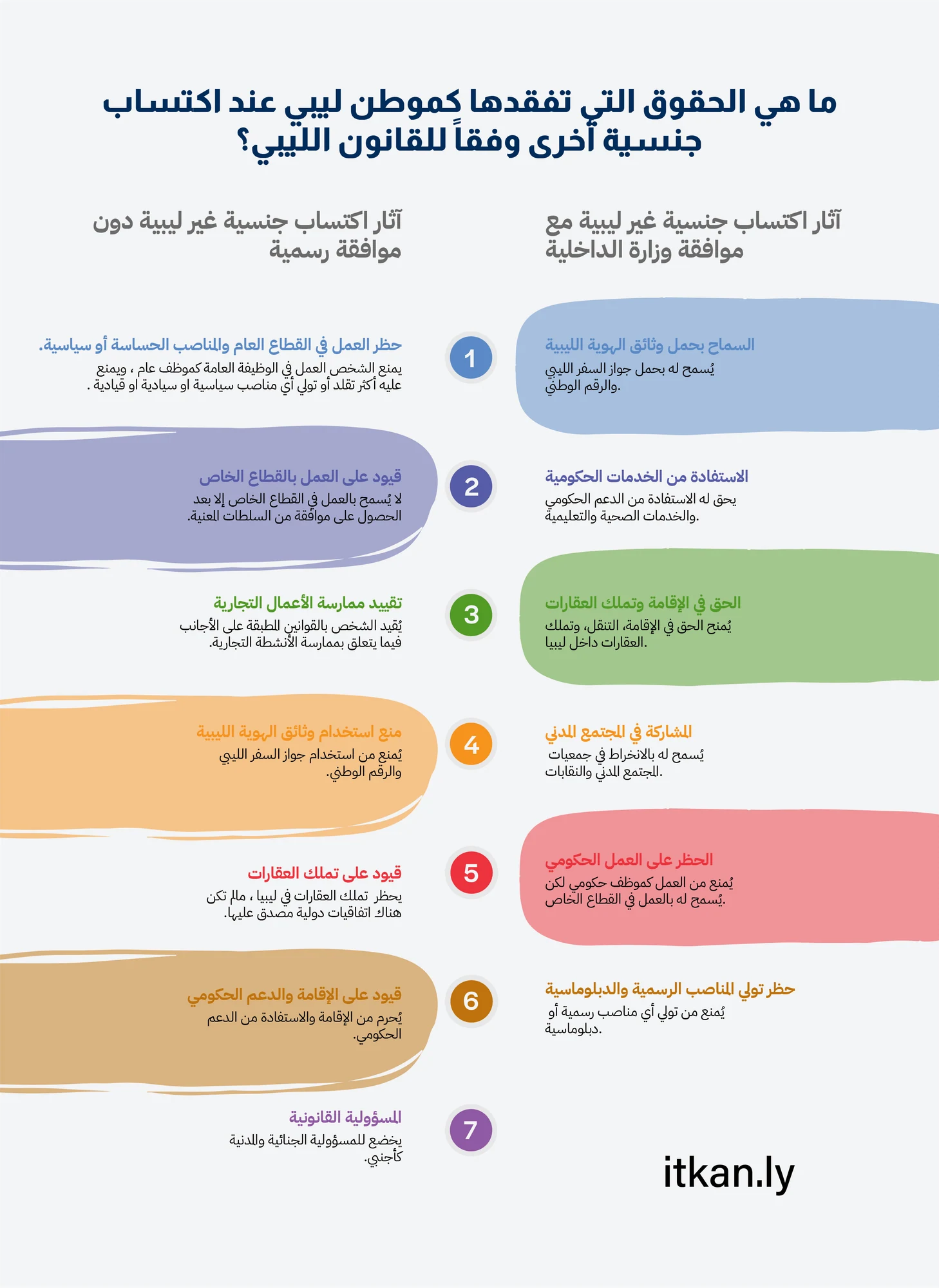
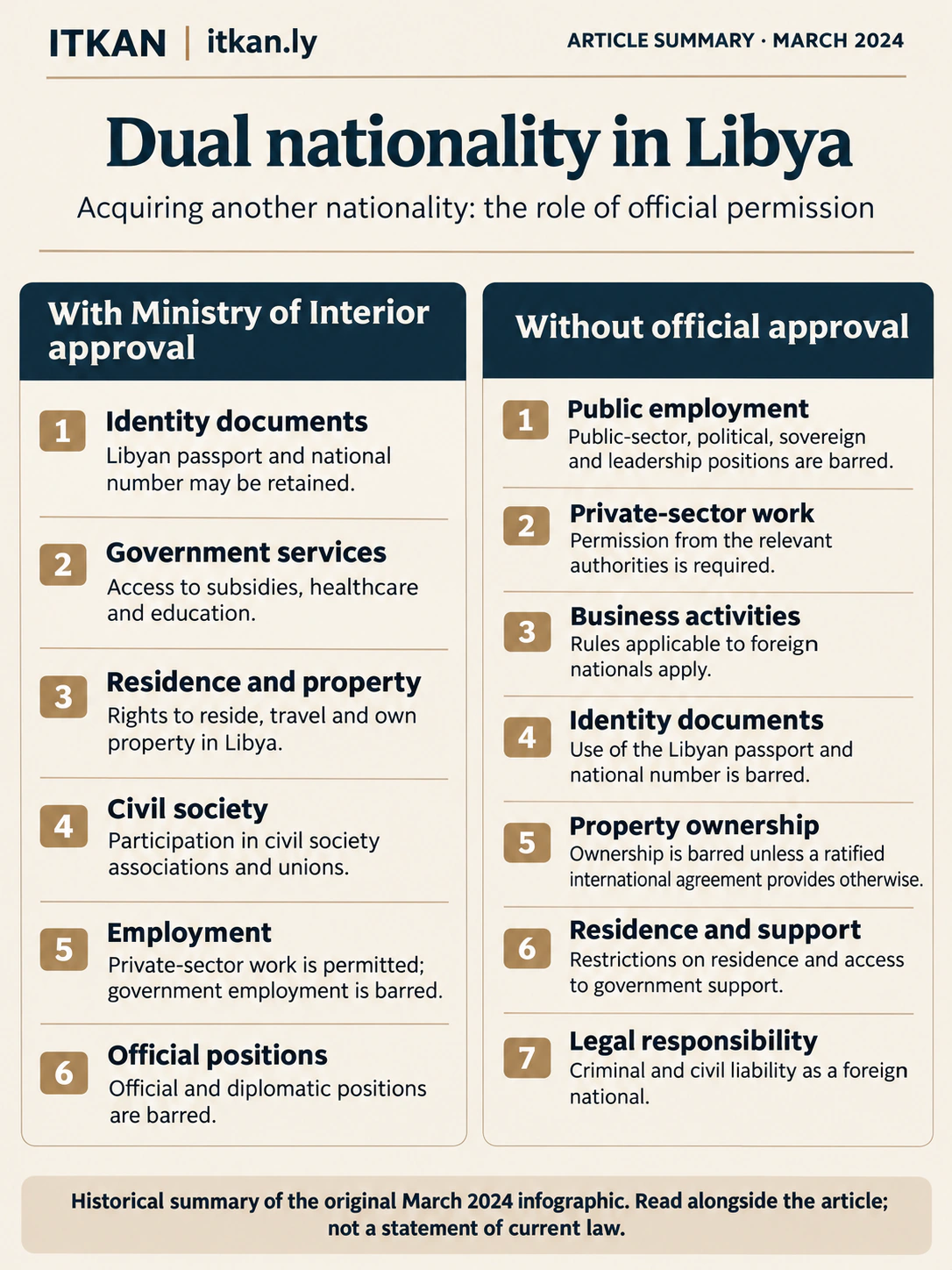
What rights do you lose as a Libyan citizen when you acquire another nationality according to Libyan law?
Read the accessible text version
With Ministry of Interior approval
- Identity documents
Libyan passport and national number may be retained.
- Government services
Access to subsidies, healthcare and education.
- Residence and property
Rights to reside, travel and own property in Libya.
- Civil society
Participation in civil society associations and unions.
- Employment
Private-sector work is permitted; government employment is barred.
- Official positions
Official and diplomatic positions are barred.
Without official approval
- Public employment
Public-sector, political, sovereign and leadership positions are barred.
- Private-sector work
Permission from the relevant authorities is required.
- Business activities
Rules applicable to foreign nationals apply.
- Identity documents
Use of the Libyan passport and national number is barred.
- Property ownership
Ownership is barred unless a ratified international agreement provides otherwise.
- Residence and support
Restrictions on residence and access to government support.
- Legal responsibility
Criminal and civil liability as a foreign national.
Article contributors
What does this mean for your business?
Discuss the issue with our team and understand the advice relevant to your matter.
Discuss this topic